In modern construction, the choice of foundation can determine the strength, stability, and longevity of a building. Raft foundations — also known as mat foundations — are one of the most reliable and versatile options, particularly when soil conditions are weak or variable.
At CJ Groundworks, we specialise in building foundations for residential, commercial, and industrial projects across the UK. This guide explains what raft foundations are, how they work, and why they’re an excellent solution for many construction sites.
1. What Are Raft Foundations?
They are a large, continuous slab of reinforced concrete that extends across the entire footprint of a building. It supports the structure by spreading the load evenly over a wide area of soil — much like a raft floating on water.
Key Features of Raft Foundations
- Covers the full area beneath a building
- Distributes loads uniformly across weak or variable soil
- Reduces differential settlement (uneven sinking)
- Combines the foundation and floor slab in one construction layer
- Suitable for both residential and commercial structures
Unlike strip or pad foundations, raft foundations support the entire structure together, rather than individual walls or columns.
2. When to Use Raft Foundations
Raft foundations are commonly used when:
- The soil has low bearing capacity (e.g. clay or loose fill).
- Loads from the structure need to be spread over a large area.
- The building has basements or heavy equipment loads.
- The structure is close to other buildings, requiring even settlement.
They’re also ideal for projects where traditional strip foundations would require deep excavation, increasing both cost and complexity.
3. How Raft Foundations Work
The concept behind raft foundations is simple but effective. The entire building sits on one continuous slab of concrete, reinforced with steel to resist tension and bending forces.
This design ensures that the building’s weight is evenly distributed across the slab and the underlying soil, preventing excessive pressure in any one area.
In essence, the raft foundation “floats” on the ground, maintaining stability even when the soil below shifts slightly due to changes in moisture or load.
4. Construction Process of Raft Foundations
Building raft foundations requires careful planning, precision, and adherence to UK construction standards. Below is a step-by-step overview:
- Site Preparation:
The ground is excavated to the required depth and levelled. - Compaction and Blinding:
A thin layer of concrete (blinding) is laid to create a smooth working surface. - Formwork Installation:
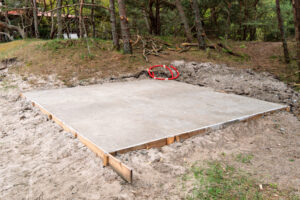
Wooden or steel formwork defines the perimeter of the slab. - Reinforcement Placement:
Steel bars or mesh are positioned according to the structural design. - Concrete Pouring:
The entire slab is poured in one operation to ensure a continuous, uniform surface. - Curing and Finishing:
The concrete is cured properly to gain strength, and the surface may be finished to form the building’s ground floor.
This process creates a strong, integrated foundation capable of supporting heavy loads.
5. Advantages of Raft Foundations
Raft foundations offer numerous benefits, particularly for challenging UK ground conditions:
- Ideal for weak soils: Distributes loads over a wider area to prevent sinking.
- Cost-effective: Reduces excavation and material use compared to deep foundations.
- Combined function: Acts as both foundation and ground floor slab.
- Reduces settlement: Prevents uneven sinking across the building footprint.
- Durable and long-lasting: Made from reinforced concrete for strength and stability.
For properties with poor soil or heavy load demands, raft foundations provide an efficient and reliable solution.
6. Disadvantages and Considerations
While raft foundations offer many advantages, they’re not suitable for every site.
Potential Drawbacks:
- Not suitable for steep sites or highly compressible soils.
- Requires precise design to ensure even load distribution.
- More complex reinforcement compared to strip foundations.
A detailed site survey and soil test should always be carried out before deciding on the best type of foundation.
CJ Groundworks provides expert site assessments and professional advice to ensure your foundation is designed for maximum safety and performance.
Learn more about our building foundation services →
7. Cost of Raft Foundations in the UK
The cost of raft foundations depends on site conditions, design requirements, and project size. On average:
- Residential raft foundation: £70–£120 per square metre
- Commercial raft foundation: £100–£200 per square metre
While a raft foundation may have a slightly higher upfront cost than strip foundations, they often save money long-term by reducing excavation, materials, and potential structural repairs.
8. Raft vs Other Foundation Types
Here’s a quick comparison of raft foundations with other common options:
- Raft vs Strip Foundation: Raft foundations spread loads across the entire footprint, while strip foundations support individual walls. Rafts are better for weak or uneven soils.
- Raft vs Pad Foundation: Rafts support the whole structure; pads support isolated columns. Rafts are ideal for heavier loads.
- Raft vs Pile Foundation: Piles transfer loads deep into the ground, while rafts distribute loads at surface level. Rafts are more economical for shallow, stable soils.
Understanding these differences helps engineers and builders choose the most efficient design for each site.
Build on Strength with Raft Foundations
Raft foundations are a proven, reliable solution for many UK construction projects, particularly where soil conditions are variable or ground-bearing capacity is low.
At CJ Groundworks, our team of experts deliver precision-engineered foundations that meet both structural and environmental standards. From design to installation, we ensure every project rests on a foundation built for durability and performance.
Contact CJ Groundworks today for professional advice or a quote on your next foundation project.
Phone: 0788 175 7877
Email: chris@cjgroundworks.com or henry@cjgroundworks.com
Frequently Asked Questions
Q1: How thick should a raft foundation be?
A1: Most raft foundations in the UK range from 150mm to 300mm thick, depending on the load and soil conditions. Structural engineers determine the exact specification for each project.
Q2: Can they be used for houses?
A2: Yes, raft foundations are commonly used in residential construction, especially for properties on soft or uneven ground where traditional foundations may not be suitable.
Q3: Are the foundations expensive?
A3: While slightly more expensive to construct than strip foundations, raft foundations can save money in the long term by reducing excavation, materials, and structural maintenance costs.