Introduction
When planning a new build or extension, one of the most common questions homeowners ask is, what is strip foundation and when should it be used? Foundations form the structural base of any building, and choosing the correct type is essential for long-term stability and compliance with UK Building Regulations.
Understanding what is strip foundation is particularly important in areas such as Surrey, Sussex and Kent, where soil conditions can vary between stable ground and shrinkable clay. Selecting the right system helps avoid settlement, cracking and costly remedial work.
At CJ Groundworks (https://cjgroundworks.com/), we install strip, raft and trench fill foundations across the South East, ensuring every project starts with a reliable structural base.
What Is Strip Foundation?
To answer clearly, what is strip foundation?
A strip foundation is a continuous strip of concrete placed beneath load-bearing walls. It transfers the weight of the structure directly to the ground below. Unlike raft systems, which cover the full building footprint, strip foundations support only the structural wall lines.
In simple terms, when someone asks what is strip foundation, the answer is: it is a traditional foundation method where concrete is poured into trenches beneath walls to distribute load to suitable bearing strata.
For technical context, see: https://en.wikipedia.org/wiki/Foundation_(engineering)
How Strip Foundations Work
Understanding what is strip foundation also involves looking at its structural function.
Strip foundations:
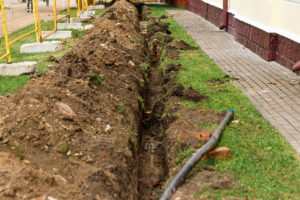
Are excavated to a depth determined by soil conditions
Are typically 600mm wide (depending on load and design)
Use mass concrete or reinforced concrete
Support load-bearing external and internal walls
The depth of a strip foundation is influenced by:
Soil bearing capacity
Presence of trees
Shrinkable clay conditions
Frost protection requirements
In many domestic projects across Surrey and Sussex, strip foundations remain a cost-effective and reliable solution.
Typical Strip Foundation Depth in the UK
A key part of answering what is strip foundation is understanding depth requirements.
In stable soil, strip foundations may be excavated to around 1 metre below ground level. However, in clay soils influenced by trees, deeper excavation may be required to reach stable strata.
Building Control will assess excavation depth before concrete is poured. If the ground is unsuitable at shallow depth, deeper strip footing or trench fill foundations may be recommended instead.
Professional groundwork contractors ensure that strip foundations meet Part A (Structure) requirements and align with engineer calculations.
What Is Strip Foundation Compared to Raft Foundations?
Strip Foundation
Supports load beneath walls only
Requires trench excavation
Suitable for stable soil conditions
Often cost-effective for smaller projects
Raft Foundation
Covers entire building footprint
Spreads load evenly
Suitable for poor or variable soil
May reduce differential settlement risk
If soil conditions are uncertain, engineers may recommend raft systems instead of traditional strip foundations.
When Is Strip Foundation Suitable?
You may consider strip foundations if:
Soil bearing capacity is good
The site is free from significant clay shrinkage risk
Excavation depth is manageable
The structure is relatively lightweight
Understanding what is strip foundation helps property owners determine whether it suits their specific project.
For many domestic extensions in Surrey and Kent, strip foundations remain the preferred solution where ground investigations confirm stable conditions.
Installation Process
When clients ask what is strip foundation in practical terms, they often want to understand the installation stages.
Typical steps include:
Marking out foundation trenches
Excavating to required depth
Inspection by Building Control
Pouring concrete
Allowing curing before blockwork begins
Accuracy during excavation is critical. Over-excavation increases cost, while insufficient depth risks non-compliance.
Working with experienced contractors ensures the finished foundation meets structural and regulatory standards.
Why Professional Groundworks Matter
Incorrectly installed strip foundations can lead to cracking, subsidence and expensive repairs. Professional assessment ensures that soil conditions are properly evaluated before work begins.
CJ Groundworks delivers compliant strip foundation installation across Surrey, Sussex, East Sussex and Kent. If you are asking what is strip foundation and whether it is suitable for your build, our experienced team can guide you through the decision-making process.
Frequently Asked Questions
Q1: How deep should a strip foundation be in clay soil?
A1: Depth depends on soil conditions and tree influence, but may exceed 1 metre in shrinkable clay areas.
Q2: Is strip foundation cheaper than raft foundation?
A2: In stable ground conditions, strip foundations are often more cost-effective due to reduced material use.
Q3: Do strip foundations require reinforcement?
A3: Mass concrete is common for domestic projects, but reinforcement may be specified depending on structural load and soil conditions.
Choosing the correct foundation system is essential for the safety and longevity of your property. If you are planning a build in Surrey, Sussex or Kent and want expert advice on what is strip foundation, speak to a trusted local specialist.
Call 0140 373 3214
Email chris@cjgroundworks.com