Introduction
Choosing the correct foundation type is one of the most important decisions in any building project. In areas such as Surrey, Sussex and Kent, ground conditions often dictate whether a standard strip footing is sufficient or whether a deep strip foundation is required.
Understanding when a deep strip foundation becomes necessary can help homeowners avoid structural risks, delays and unexpected costs. Where soil conditions are poor or influenced by trees, deeper excavation may be essential to reach stable bearing strata.
At CJ Groundworks (https://cjgroundworks.com/), we install both standard and deep strip systems across the South East, ensuring foundations meet engineer specifications and UK Building Regulations.
What Is a Deep Strip Foundation?
A deep strip foundation is a variation of the traditional strip foundation. It follows the same principle of supporting load-bearing walls with continuous concrete strips, but the excavation depth is significantly greater.
The increased depth allows the foundation to:
Reach stable ground below problematic soil layers
Avoid the influence of tree roots
Reduce the risk of clay shrinkage movement
Improve overall structural stability
In many parts of Surrey and Sussex, clay soils can expand and contract seasonally. A deeper foundation mitigates this risk.
For background on foundation types, see: https://en.wikipedia.org/wiki/Foundation_(engineering)
Why Deep Strip Foundations Are Common in Clay Areas
Clay soils are highly reactive to moisture changes. During dry summers, clay can shrink. In wetter periods, it expands. This cyclical movement can affect shallow foundations.
A deep strip foundation reduces the risk of structural damage by extending below the zone most affected by seasonal movement.
Tree influence is another key factor. Large trees draw moisture from surrounding soil, increasing shrinkage risk. Building Control may require a deeper foundation where mature trees are present within influencing distance.
Across Surrey, Kent and Sussex, this is a common requirement for domestic extensions.
How Deep Strip Foundations Are Constructed
When installing a deep strip foundation, contractors must carefully follow engineer guidance and Building Control requirements.
Typical stages include:
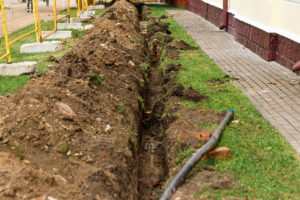
Excavation to specified depth
Inspection by Building Control
Ensuring trench sides remain stable
Pouring concrete to required level
Allowing sufficient curing time
Excavation depth can vary significantly depending on site conditions. In some cases, trenches may exceed 1.5 metres.
Safety is critical during deep excavations. Proper trench support and safe working practices must be followed at all times.
Deep Strip Foundation vs Trench Fill
Deep Strip Foundation
Concrete placed at base of trench
Brick or blockwork built up to ground level
Requires stable trench sides
Trench Fill Foundation
Concrete fills entire trench nearly to ground level
Reduces need for brickwork below ground
Often used where trench sides are unstable
Both systems are designed to achieve similar structural outcomes. The choice depends on soil stability, cost considerations and engineer recommendations.
When Is a Deep Strip Foundation Required?
A deep strip foundation may be specified if:
Clay shrinkage risk is present
Trees are within influencing distance
Ground investigations show weak upper soil layers
Building Control requests additional depth
Understanding these triggers helps homeowners prepare for excavation depth requirements before work begins.
In many domestic projects across Surrey and Sussex, deeper foundations are not unusual, particularly where extensions are added to older properties.
Cost Considerations
Excavating for a deep strip foundation generally increases labour, disposal and material costs compared to shallow strip systems. However, avoiding structural issues later provides long-term value.
Proper ground investigation and structural design prevent over-excavation while ensuring compliance.
Working with experienced contractors ensures depth requirements are neither underestimated nor unnecessarily excessive.
Why Professional Installation Matters
Deep excavation requires skill, planning and strict safety procedures. Incorrect depth or poorly compacted concrete can compromise structural integrity.
CJ Groundworks delivers professionally installed foundation systems across Surrey, Sussex, East Sussex and Kent. Our team works closely with structural engineers and Building Control officers to ensure compliance at every stage.
If you are planning an extension or new build and suspect ground conditions may require deeper foundations, early consultation can help avoid delays.
Frequently Asked Questions
Q1: How deep is a deep strip foundation?
A1: Depth varies depending on soil conditions and tree influence, but may exceed 1.5 metres in some clay areas.
Q2: Is a deep strip foundation stronger than a standard strip foundation?
A2: It provides improved stability in challenging ground conditions but follows the same structural principle as standard strip foundations.
Q3: Does a deep strip foundation cost more?
A3: Yes, due to increased excavation and concrete volume, but it helps prevent costly structural problems later.
Starting your project with the correct foundation depth ensures structural stability and regulatory compliance. If you need expert advice on installing a deep strip foundation in Surrey, Sussex or Kent, speak to a trusted local specialist.
Call 0140 373 3214
Email chris@cjgroundworks.com