Poor drainage can damage a property in several ways, from persistent damp and water entering buildings to deterioration of external surfaces and, in certain circumstances, problems affecting the ground around foundations. The severity depends on where the water collects, how frequently it occurs and whether it can escape through a suitable drainage route.
A garden that remains waterlogged after heavy rainfall may initially seem like a landscaping inconvenience. However, if water repeatedly accumulates against external walls, flows towards the building or saturates the ground surrounding structural elements, the consequences can become more serious.
Understanding how poor drainage causes property damage is important because visible symptoms do not always reveal the underlying problem. Repairing damp plaster or replacing damaged paving, for example, may provide only temporary relief if excess water continues to collect in the same location.
How Does Poor Drainage Allow Water to Damage a Building?
Buildings are designed to resist normal exposure to rain and ground moisture, but their protection depends partly on water being managed appropriately around them.
Surface water should be directed away from vulnerable areas or collected and discharged through suitable drainage systems. Underground pipes must also remain capable of carrying wastewater and rainwater to their intended destinations.
Problems arise when these arrangements become ineffective.
Water collecting against external walls
If the ground beside a building slopes towards it, rainwater may accumulate against the walls rather than draining away.
This can become particularly troublesome where external ground levels are high, drainage channels are obstructed or surrounding surfaces have been altered without considering how water will flow.
For example, suppose a paved patio is installed with a slight fall towards the house. During heavy rain, water may travel across the paving and collect alongside the external wall.
If the patio also sits too high relative to the building’s damp-proof course, the situation may increase the risk of moisture penetrating vulnerable parts of the wall.
Over time, persistent moisture exposure can contribute to deterioration of external finishes and damp problems inside the property.
However, a damp wall does not automatically indicate defective ground drainage. Leaking gutters, damaged masonry, plumbing leaks, condensation and other defects can produce similar symptoms.
The source of moisture must be established before deciding which repair is appropriate.
Water entering through vulnerable openings
Poor surface water drainage can allow water to accumulate around external doors, basement entrances, low-level vents and other openings.
During intense rainfall, these areas may become vulnerable if the surrounding ground cannot drain water away quickly enough.
A property with a sloping driveway leading down to a garage is a useful example.
If water flows towards the garage and there is no adequate interception drainage, it may collect against the door and eventually enter the building.
Once inside, water can damage floor coverings, plaster, electrical installations, stored belongings and internal finishes.
The Environment Agency’s guidance on protecting properties against flooding explains that practical measures can help reduce the amount of water entering buildings and limit the damage it causes.
The appropriate solution depends on where the water originates and how it reaches the property.
Can Poor Drainage Damage Building Foundations?
Persistent drainage problems can affect the ground supporting a building, but the relationship between water and foundation damage is more complicated than simply assuming that wet ground causes subsidence.
Foundations are designed to transfer structural loads into suitable supporting ground. Their performance depends on several factors, including soil type, foundation design, groundwater conditions and changes to the surrounding environment.
How changing moisture levels affect clay soil
Clay soil is particularly sensitive to changes in moisture content.
Some clay soils shrink as they dry and expand when they absorb water. If these changes occur unevenly beneath or alongside a building, they can contribute to ground movement.
A leaking underground drain may increase moisture locally, while prolonged dry conditions or nearby vegetation can produce different moisture changes.
The resulting movement can place additional stresses on foundations and the structure above.
However, not every drainage problem causes foundation movement, and not every crack in a building is evidence of drainage-related damage.
Structural concerns require appropriate investigation rather than assumptions based on surface conditions alone.
Erosion and loss of supporting ground
Water escaping from damaged drainage pipes can sometimes wash fine soil particles away from their surroundings.
Where this process continues, the ground may lose material and develop voids or localised areas of weakness.
The risk depends on the nature of the soil, the volume and movement of water, the location of the leak and the proximity of structures.
For example, a damaged underground pipe beneath a paved area might allow water to carry surrounding material away. Over time, this could contribute to settlement of the surface.
Where foundations or other structural elements may be affected, further assessment is necessary.
This illustrates why a recurring drainage problem should not be dismissed simply because the visible leak or blockage appears minor.
Why saturated ground does not always mean structural failure
It is important to distinguish between waterlogged ground and confirmed structural damage.
Some sites naturally experience seasonal changes in groundwater levels. Others have drainage systems specifically designed to manage these conditions.
A wet garden does not necessarily indicate that the house foundations are at risk.
The more relevant questions are whether water conditions have changed, whether ground movement is occurring and whether the drainage system is functioning as intended.
If cracking, settlement or suspected foundation movement is present, an appropriately qualified structural engineer may need to assess the building alongside any drainage investigation.
What Damage Can Poor Drainage Cause to Driveways and Paths?
Drainage problems are not limited to buildings.
Driveways, patios, footpaths and other external surfaces depend on suitable construction and water management.
Settlement and uneven surfaces
If water repeatedly enters the layers beneath a driveway or path, it may contribute to deterioration of the supporting material.
Where water movement washes away fine particles or the sub-base becomes unstable, the surface above may begin to settle.
Possible consequences include uneven paving, depressions and localised cracking.
However, poor compaction, unsuitable materials and construction defects can also produce similar problems.
Replacing the damaged surface without investigating the cause may allow the same issue to develop again.
Potholes and surface deterioration
Standing water can accelerate deterioration where a surface already has weaknesses.
On asphalt driveways, for example, water entering cracks or damaged joints may contribute to the breakdown of the surrounding material.
Repeated vehicle loads can worsen the deterioration, particularly where supporting layers have been affected.
Concrete surfaces may also develop problems where ground movement causes uneven support.
Effective drainage therefore protects not only the appearance of external areas but also their long-term performance.
Why surface levels matter
A driveway does not necessarily need extensive drainage infrastructure to function correctly, but water must have somewhere appropriate to go.
The direction of the surface fall is particularly important.
Consider two otherwise identical driveways.
One slopes gently towards a suitable drainage channel. The other directs water towards the garage entrance.
Even if both surfaces are constructed from the same materials, their drainage arrangements create very different risks.
This is why ground levels and discharge arrangements should be considered together when planning external construction.
How Can Poor Drainage Affect Gardens and Outdoor Spaces?
Waterlogged gardens are often associated with heavy rainfall, but persistent saturation can indicate that water is not moving through or away from the ground effectively.
Possible causes include compacted soil, low-permeability ground, poorly positioned surface levels or inadequate drainage infrastructure.
Damage to lawns and planting
When soil remains saturated, the spaces that would normally contain air become filled with water.
Plant roots need oxygen to function, so prolonged waterlogging can restrict healthy growth.
Lawns may become muddy and difficult to use, while some plants may struggle to establish or survive.
The problem can become more pronounced in areas regularly walked or driven over because repeated loading may compact the soil further.
Water collecting around outbuildings
Sheds, garages and garden rooms also depend on appropriate ground preparation and drainage.
If water consistently collects around a building, it may affect surrounding surfaces and increase moisture exposure to vulnerable parts of the structure.
For example, timber elements close to persistently wet ground may be at greater risk of deterioration if they are not adequately protected.
Similarly, a poorly prepared concrete base may be affected by unstable supporting ground.
The correct solution depends on whether the problem involves surface levels, drainage capacity, soil conditions or the construction of the base itself.
CJ Groundworks undertakes both concrete base installation and surface water drainage work, making these closely related considerations when preparing sites for garden buildings and other structures.
Can Blocked or Damaged Drains Cause More Serious Problems?
A blocked drain can create problems beyond slow drainage or unpleasant smells.
When wastewater or rainwater cannot flow through its intended route, it may back up, overflow or escape through weaknesses in the system.
Wastewater backing up into a property
Foul water drainage carries wastewater from toilets, sinks, baths and other sanitary installations.
If the system becomes severely blocked, wastewater may back up through low-level fixtures or inspection chambers.
Where sewage enters a building, the consequences can include contaminated surfaces, damaged belongings and substantial cleaning requirements.
This presents a different level of concern from ordinary surface water collecting in a garden.
Sewage-contaminated water should be treated as a health hazard, and affected areas may require specialist cleaning and appropriate precautions.
Water escaping from damaged underground pipes
Underground drains can suffer damage through ground movement, deterioration, external loading or other factors.
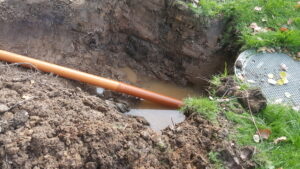
Cracked or displaced pipework may allow water to escape into the surrounding soil.
Depending on the circumstances, this can contribute to localised saturation or erosion of supporting material.
Because the pipework is buried, the visible effect may appear some distance from the actual defect.
A recurring wet patch, for example, does not establish the location or cause of a pipe failure without further investigation.
Why simply clearing a blockage may not be enough
Removing an obstruction can restore drainage flow, but it may not correct the reason the blockage developed.
A pipe with displaced joints, structural damage or other defects might become obstructed again.
This is where inspection becomes important.
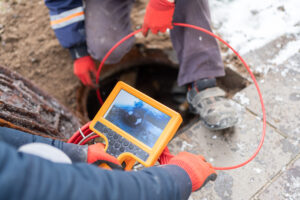
A CCTV drain survey can help identify defects within accessible underground drainage pipes, allowing repair decisions to be based on the condition of the system rather than repeated attempts to clear the symptoms.
Why Can Drainage Damage Become More Expensive Over Time?
The cost of drainage-related property damage is influenced by what has been affected and how accessible the problem is.
A blocked external drain may be relatively straightforward to investigate and clear. A concealed leak that has damaged surrounding ground or internal finishes may involve significantly more work.
The expense can increase when damage spreads beyond the original drainage defect.
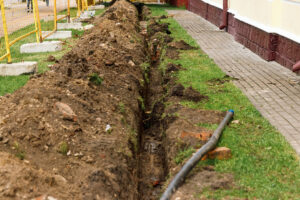
For example, a leaking underground pipe beneath a driveway might eventually require pipe repairs, excavation, reinstatement of supporting materials and replacement of part of the finished surface.
If water has also entered a building, additional drying and repair work may be necessary.
There is an important distinction between repairing the drainage fault and repairing the damage caused by that fault.
Both may be required.
Delaying investigation does not guarantee that damage will worsen, but it increases the possibility that an unresolved problem will continue affecting surrounding materials.
It can also make diagnosis more difficult if multiple symptoms develop.
How Can You Establish Whether Drainage Is Responsible for Property Damage?
The most effective approach is to investigate the source of water before selecting a repair.
Not every damp patch, cracked surface or wet garden is caused by a defective drainage system.
A structured assessment helps distinguish between different possibilities.
Start by identifying when the problem occurs
The timing of water accumulation can provide useful clues.
For example:
- Water appearing only during heavy rainfall may suggest a surface water management issue.
- Persistent wet ground during dry weather may justify checking for leaking pipes or other water sources.
- Wastewater backing up when appliances or toilets are used may indicate a foul drainage restriction.
- A recurring problem after drain clearance may suggest an underlying defect requiring inspection.
These patterns are useful starting points, not definitive diagnoses.
Consider whether the drainage system has changed
Problems sometimes develop after building or landscaping work.
A new patio, driveway or extension can alter how water moves around a property.
Drainage routes may also have been modified, covered or damaged during construction.
If a problem began after such work, reviewing the changes can help narrow the investigation.
For properties across Sussex, Surrey and Kent, the appropriate drainage approach will depend on site-specific conditions rather than a standard solution for every location.
Choose an investigation that matches the suspected problem
Different drainage problems require different methods of investigation.
A CCTV survey may be useful where underground pipe damage or recurring blockages are suspected.
Surface water problems may require assessment of ground levels, collection points, soil permeability and available discharge routes.
Suspected structural movement may require engineering assessment in addition to drainage investigations.
Understanding the likely cause first helps avoid spending money on work that addresses only the visible symptom.
What Can Be Done to Reduce Future Drainage Damage?
Preventing further damage usually involves correcting the reason water is collecting or escaping.
For some properties, that may mean repairing damaged pipework or clearing an obstruction.
Others may need improved surface water drainage, adjusted ground levels or a properly designed system to manage runoff.
Solutions can include soakaways, French drains, drainage channels and other appropriate arrangements, depending on the source of water and the conditions on site.
These options are not interchangeable.
A soakaway, for example, depends on suitable ground infiltration conditions and adequate separation from buildings and other constraints.
A French drain may help collect or redirect water in certain situations, but it still requires a suitable destination for that water.
Installing drainage without establishing where water can lawfully and effectively discharge may simply move the problem elsewhere.
The Environment Agency explains that surface water flooding occurs when rainwater cannot drain away or soak into the ground and instead flows across or accumulates on the surface.
Understanding how water moves across a site is therefore central to selecting an appropriate solution.
Frequently Asked Questions
Can poor drainage cause cracks in walls?
Poor drainage can contribute to ground movement in certain circumstances, particularly where changing moisture conditions or leaking pipes affect supporting soil. However, wall cracks have many possible causes. Structural investigation may be needed to establish whether drainage is involved.
Does standing water always mean a drainage system is faulty?
No. Standing water may result from compacted soil, low-permeability ground, natural site levels or unusually heavy rainfall. A defective drain is only one possible explanation.
Can drainage problems affect a property’s insurance?
Insurance cover depends on the policy and the cause of damage. Sudden insured events may be treated differently from gradual deterioration or inadequate maintenance. Check the relevant policy terms and contact the insurer before undertaking major repairs following damage.
Can a CCTV drain survey detect every drainage problem?
No. CCTV surveys are useful for inspecting the inside of accessible drainage pipes, but they do not directly measure soil permeability, identify every external water source or replace a structural investigation. Other assessments may be required.
Should you repair drainage before replacing damaged paving?
Where drainage has contributed to settlement or surface deterioration, it is generally sensible to identify and address the cause before reinstating the paving. Otherwise, the new surface may be exposed to the same conditions.
Protecting Your Property Starts With Understanding the Cause
Poor drainage can have consequences far beyond temporary puddles or an untidy garden. Depending on the circumstances, uncontrolled water can damage building finishes, affect outdoor surfaces, create wastewater problems and contribute to deterioration of the ground supporting structures.
The most effective response is not necessarily the most extensive drainage installation. It is the solution that addresses the actual cause.
A recurring problem deserves investigation, particularly when water is entering the building, external surfaces are settling or underground drainage is suspected of leaking.
CJ Groundworks provides drainage services across Sussex, Surrey and Kent, including surface water drainage, drain repairs, CCTV drain surveys, soakaways and French drains. With over 35 years of experience in groundworks and drainage, the family-run company can help property owners assess the work needed to address drainage-related problems.
To discuss drainage concerns at your property, contact CJ Groundworks.
Phone: 0140 373 3214
Email: chris@cjgroundworks.com
Find out more: https://cjgroundworks.com/