A cesspit can be a practical off-mains drainage solution when a property cannot connect to a public foul sewer and there is no acceptable way to discharge treated wastewater into the ground or a watercourse.
Unlike a septic tank or sewage treatment plant, a cesspit does not treat sewage. It is a sealed underground storage tank that holds all foul wastewater from the property until a registered waste carrier removes it.
This makes cesspit installation a relatively straightforward option from a discharge perspective because no sewage effluent is released into the environment. However, every litre that enters the tank must eventually be collected and transported away. Regular emptying can therefore make a cesspit considerably more expensive to operate than a treatment system.
A cesspit is usually best treated as a site-specific solution rather than the default choice for any rural property. It may be appropriate where difficult ground, environmental restrictions or a lack of available land prevents the use of a drainage field or treatment plant discharge.
How does a cesspit work?
All foul wastewater from the property flows through underground drainage pipes into a watertight tank.
This normally includes wastewater from:
- Toilets
- Baths and showers
- Bathroom basins
- Kitchen sinks
- Washing machines
- Dishwashers
- Utility rooms
The sewage remains inside the tank. There is no outlet pipe, drainage field or environmental discharge.
As the level rises, the cesspit must be emptied by a tanker before it becomes full. GOV.UK guidance says owners must ensure a cesspool is emptied regularly by a registered waste carrier and does not leak or overflow. It gives monthly emptying as an example, although the actual frequency depends on the tank capacity and wastewater usage.
Some systems include a high-level alarm that warns the property owner when the tank is approaching its operating limit. The alarm provides useful notice, but it should not replace routine level checks and a planned emptying schedule.
Is there a difference between a cesspit and a cesspool?
The terms are generally used interchangeably in the UK. Both usually describe a sealed sewage storage tank with no outlet.
A cesspit should not be confused with a septic tank. A septic tank partially treats sewage and releases liquid effluent into a drainage field. A cesspit stores the entire volume without treatment or discharge.
That distinction affects installation, regulation, maintenance and running costs.
When might a cesspit be the right choice?
A cesspit may be suitable when four broad conditions apply:
- A connection to the public foul sewer is not reasonably available.
- A septic tank drainage field cannot be installed successfully.
- A sewage treatment plant has no acceptable discharge route.
- The owner can support reliable tanker access and frequent emptying.
These conditions commonly arise at isolated rural properties, restricted sites and environmentally sensitive locations.
A proper assessment is still required. Choosing a cesspit because it appears simpler to install can lead to high long-term costs if the property produces a substantial volume of wastewater.
When is a mains sewer connection unavailable?
Connection to the public foul sewer is generally preferable where it is reasonably available. It removes the need to store, treat or arrange disposal of sewage on the property.
However, some rural buildings are located a considerable distance from the sewer network. Connecting may involve:
- Excavating across fields or roads
- Crossing land owned by another party
- Installing a pumping station
- Negotiating easements or access rights
- Overcoming difficult ground levels
- Obtaining approval from the sewerage undertaker
- Paying substantial connection and construction costs
Where a public sewer connection is not reasonably achievable, an off-mains solution must be considered.
A cesspit may then become one of several options alongside a septic tank or sewage treatment plant. It should not be selected until the discharge-based alternatives have also been assessed.
When is the ground unsuitable for a drainage field?
A septic tank normally releases effluent into the ground through a properly designed drainage field. The soil must be capable of absorbing and treating that liquid without causing pollution or allowing sewage to appear at the surface.
Government guidance states that a septic tank or small sewage treatment plant discharging to the ground must use a drainage field. Septic tank effluent cannot be discharged directly to a watercourse.
A drainage field may be unsuitable where:
- The soil drains too slowly
- The ground drains excessively quickly
- Seasonal groundwater is too high
- The site is frequently waterlogged
- Bedrock is close to the surface
- The available land is too small
- The ground is steeply sloped
- Required separation distances cannot be achieved
- Wells, springs or boreholes are nearby
- The land is vulnerable to flooding
- The proposed area is already occupied by buildings or hard landscaping
Percolation and site tests help determine whether the soil can accept effluent at an appropriate rate.
If the ground does not provide suitable conditions, installing a septic tank with an inadequate drainage field can result in sewage backing up, surfacing in the garden or polluting groundwater.
A sealed cesspit avoids the need for a drainage field because it does not discharge any effluent.
When might a treatment plant discharge be impossible?
A sewage treatment plant treats wastewater to a higher standard than a septic tank. Depending on the site and applicable rules, treated effluent may discharge to the ground or suitable surface water.
However, a treatment plant still needs an acceptable outlet.
A surface water discharge must comply with the Environment Agency’s requirements. It cannot be assumed that any nearby ditch, stream or pond is a suitable discharge point. The system must meet the relevant conditions, remain within the applicable volume limits and avoid pollution.
A discharge may be impractical where:
- There is no watercourse nearby
- The available ditch does not provide a suitable flow route
- The property does not control the land needed for the outlet
- Ground conditions prevent infiltration
- Environmental restrictions apply
- A permit cannot be obtained
- The discharge could affect protected groundwater
- The outlet would cross neighbouring land
- Flooding could interfere with the discharge
In these situations, a cesspit may provide a contained alternative because nothing is discharged outside the tank.
Are cesspits suitable for environmentally sensitive sites?
They can be considered where any environmental discharge would create unacceptable risk, provided the tank remains completely watertight and is managed properly.
Because a cesspit retains all sewage, it can avoid direct discharge near:
- Sensitive groundwater
- Wells and boreholes
- Watercourses
- Protected habitats
- Areas with unsuitable infiltration conditions
Containment does not remove every environmental risk. A leaking or overflowing cesspit can release raw sewage into the ground, which may be more damaging than a properly functioning treatment system.
GOV.UK requires cesspool operators to maintain the installation and prevent leaks and overflows. The Environment Agency can require a permit in individual circumstances, although cesspools do not normally operate under the general binding rules used for septic tanks and treatment plants.
The tank, pipe connections and access covers therefore need to remain structurally sound throughout the installation’s life.
Is a cesspit suitable for a permanently occupied house?
It can serve a permanent home, but running costs and emptying frequency need careful consideration.
A household produces wastewater every day through washing, cooking, cleaning and toilet use. Because none of this liquid leaves the cesspit naturally, the tank may fill more quickly than owners expect.
Higher usage can result from:
- A larger household
- Frequent bathing or showering
- Dishwashers
- Washing machines
- Guests
- Home-based businesses
- Additional bathrooms
- Leaking taps or toilets
A cesspit that appears affordable during installation may become costly over many years of tanker visits.
Owners should estimate annual wastewater production, realistic emptying frequency and local collection costs before choosing the system. The calculation should include normal peak use rather than relying on unusually low consumption.
Can a cesspit be useful for a building with occasional use?
A cesspit may be more practical for a property that produces relatively little wastewater or is only used intermittently.
Examples might include certain:
- Seasonal rural buildings
- Small workplaces
- Remote facilities
- Occasionally occupied premises
- Buildings where discharge is prohibited
Suitability depends on the actual use and required approvals. A holiday property with frequent guests could produce more wastewater than expected even if it is not occupied every week of the year.
Commercial use can also create variable or concentrated flows. The tank must be sized for realistic demand, and emptying access must remain available during busy periods.
How large does a cesspit need to be?
Approved Document H provides guidance for foul drainage systems in England, including cesspools. Local building control guidance commonly interprets this as requiring at least 18 cubic metres of capacity or sufficient storage for approximately 45 days, whichever produces the necessary capacity for the premises.
The final capacity should take account of:
- Number of occupants
- Type of property
- Expected daily wastewater production
- Frequency of occupation
- Commercial or domestic use
- Available tanker schedule
- Emergency storage allowance
- Access and site restrictions
A larger tank may reduce the frequency of emptying, but it also requires more excavation and available land. It does not reduce the total annual volume that must be removed.
Tank size should therefore be assessed alongside installation cost, emptying cost and site access.
Why should rainwater be kept out?
Roof water, driveway drainage and other surface water should not enter a cesspit.
Approved Document H states that surface water should not be discharged into a cesspool or septic tank.
Allowing rainwater into the tank can:
- Fill it rapidly during storms
- Increase emptying costs
- Trigger unnecessary alarms
- Raise the risk of overflow
- Reduce available capacity for foul sewage
- Overload connecting pipework
Foul and surface water drainage should be designed as separate systems. The surface water may need a soakaway, stormwater system or other approved solution.
How often does a cesspit need emptying?
There is no single schedule suitable for every property.
GOV.UK says a cesspool must be emptied regularly by a registered waste carrier and gives once a month as an example.
Some properties may need more frequent collections, while a lightly used building with a sufficiently large tank may require fewer visits.
Emptying frequency depends on:
- Tank capacity
- Number of users
- Water consumption
- Leaks or dripping appliances
- Occupancy patterns
- Whether surface water is entering incorrectly
- Time since the previous collection
The owner should not wait for sewage to back up into the property before arranging emptying.
A planned schedule, supported by level monitoring and a working alarm, provides greater protection against overflow.
What does cesspit emptying involve?
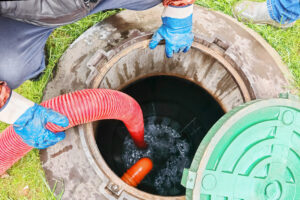
A tanker accesses the cesspit through its service cover and removes the stored sewage.
The waste must be handled and transported legally. GOV.UK specifically requires cesspool emptying to be carried out by a registered waste carrier. The Environment Agency maintains a public register that can be used to check whether a carrier is registered.
The tanker needs to park within a practical distance of the access point. Long hose runs, steep approaches, soft ground and narrow entrances can make collection more difficult.
Before installation, the site plan should consider:
- Vehicle width and height
- Gate access
- Turning space
- Ground strength
- Distance from parking to the tank
- Overhead branches or cables
- Year-round accessibility
- Security arrangements
Poor tanker access can increase collection costs or make routine emptying unreliable.
What are the main advantages of a cesspit?
A cesspit can offer several advantages in the right circumstances.
No environmental discharge
The tank retains all sewage, so no drainage field or watercourse outlet is required.
This is the main reason a cesspit may be selected for a difficult site.
Relatively simple operation
A cesspit has no biological treatment process to manage.
It generally does not require the blowers, aeration systems and other treatment components associated with many sewage treatment plants.
Suitable for restricted discharge locations
It may provide an option where groundwater, soil, land availability or environmental restrictions prevent another off-mains system from discharging safely.
Predictable waste removal
All sewage is collected by tanker rather than relying on ground infiltration or a receiving watercourse.
This can make containment straightforward, provided the emptying schedule is reliable.
What are the disadvantages of a cesspit?
The main disadvantages relate to running cost, capacity and owner responsibility.
Frequent emptying
Every litre must be transported away. A permanently occupied home may therefore require regular tanker visits.
Ongoing cost
Emptying is a permanent operating expense. Costs may rise with household use, collection charges, access difficulties and travel distance.
Overflow risk
Missed collections, unusually high usage or alarm failure can cause the tank to become dangerously full.
No treatment
The contents remain raw sewage. Any leak can therefore create a serious hygiene and pollution problem.
Space and access requirements
A large underground tank, excavation area and tanker access route are all needed.
Dependence on collections
The system cannot continue operating indefinitely if tanker services are disrupted.
These disadvantages mean a cesspit is often less desirable where a compliant septic tank or treatment plant can operate successfully.
What happens if a cesspit leaks or overflows?
A leaking cesspit can contaminate soil and groundwater and may produce sewage smells, wet ground or visible effluent.
An overflow can also allow sewage to back up through drains and enter the building.
Possible warning signs include:
- A high-level alarm
- Slow toilets or drains
- Sewage smells near the tank
- Wet or unusually green ground
- Cracks around the access cover
- Visible effluent
- Unexpectedly rapid loss of tank contents
- Frequent need for top-up emptying arrangements
Owners are required to prevent leaks and overflows.
Where leakage is suspected, water use should be reduced and a professional should inspect the system promptly. Emptying the tank may be necessary before repairs can be completed safely.
The surrounding ground may also need assessment if sewage has escaped.
What maintenance does a cesspit need?
A cesspit does not have a treatment process to service, but it still requires active management.
Maintenance should include:
- Regular level checks
- Scheduled emptying
- Testing the high-level alarm
- Inspecting covers and seals
- Checking inlet pipes
- Watching for settlement or cracking
- Keeping access clear
- Retaining collection records
- Preventing rainwater connections
- Addressing unusual smells promptly
The access cover should remain secure to prevent falls and unauthorised entry.
No one should enter a cesspit. Sewage tanks are confined spaces that can contain dangerous gases and insufficient oxygen. Inspection and repair should be left to trained professionals using appropriate equipment and procedures.
Does a cesspit need planning or Building Regulations approval?
Installing a cesspit may involve planning, Building Regulations and environmental considerations.
Approved Document H covers foul water drainage arrangements, including cesspools, drainage pipework, access and capacity.
Depending on the project, approval may also be needed for:
- A new building
- Change of property use
- Excavation near boundaries
- Access construction
- Work near a watercourse
- Development in a protected location
The general binding rules for small sewage discharges do not apply to a cesspool because it has no discharge. GOV.UK says a permit is not normally needed unless the Environment Agency specifically requires one.
This does not remove the need to comply with building control, planning and waste-handling requirements.
Requirements should be checked before excavation begins.
Where should a cesspit be positioned?
The location must balance building protection, access, ground conditions and future maintenance.
Local Building Regulations guidance commonly specifies that a cesspool should be at least 15 metres from a habitable building and positioned so it can be accessed for emptying.
The site assessment should also consider:
- Boundaries
- Existing foundations
- Underground services
- Trees
- Groundwater
- Flood risk
- Driveways and vehicle loading
- Future extensions
- Tanker access
- Pipe gradients
- Finished ground levels
The tank should not be placed where future construction could block access or impose unsuitable loads above it.
A long or complicated inlet drain can also create maintenance problems. The relationship between the property, tank and tanker access point should be planned as one system.
How does a cesspit compare with a septic tank?
A septic tank is usually more economical to operate where a compliant drainage field is available.
Once solids settle in the septic tank, liquid effluent flows into the ground. Only accumulated sludge needs periodic removal.
A cesspit stores both solids and liquids, so it fills much more quickly.
A cesspit may be more suitable where:
- The soil cannot accept effluent
- There is no room for a drainage field
- Groundwater restrictions apply
- No acceptable surface water outlet exists
- Full containment is necessary
A septic tank may be preferable where:
- Percolation testing confirms suitable ground
- There is enough land for a compliant drainage field
- Environmental restrictions can be met
- Lower long-term collection costs are important
CJ Groundworks provides both cesspit installation and septic tank installation. The choice should be based on the site rather than personal preference alone.
How does a cesspit compare with a sewage treatment plant?
A sewage treatment plant can reduce long-term tanker costs because treated effluent leaves the system through an approved discharge route. The plant still needs servicing and periodic sludge removal, but it does not store every litre of wastewater.
A treatment plant may be the stronger long-term option where:
- A compliant discharge route exists
- Electricity is available
- Regular servicing can be arranged
- The property has consistent occupancy
- The site can accommodate the installation
A cesspit may be considered where:
- No discharge route is available
- Environmental containment is essential
- Electricity or plant operation is impractical
- Wastewater volumes are low enough to make emptying manageable
- Tanker access is reliable
A sewage treatment plant involves more treatment equipment, while a cesspit involves greater dependence on collection.
The total cost over the expected life of the system should be considered, not only the installation quotation.
What should be assessed before installation?
A professional site assessment should establish whether a cesspit is necessary and whether it can operate safely.
The assessment should cover:
- Availability of a public foul sewer
- Suitability of the ground for a drainage field
- Availability of a treatment plant discharge route
- Expected wastewater volume
- Required tank capacity
- Excavation and ground conditions
- Tanker access
- Building and boundary distances
- Flood and groundwater risks
- Planning and Building Regulations requirements
- Long-term emptying costs
- Future development plans
Skipping this assessment can result in a tank that is too small, inaccessible or unnecessarily expensive to operate.
CJ Groundworks can coordinate the associated groundworks and excavation, including site preparation, trenching and connection of the foul drainage system.
Frequently Asked Questions
Does a cesspit discharge into the ground?
No. A cesspit is a sealed storage tank with no outlet. All sewage remains inside until it is collected by a registered waste carrier.
Does a cesspit need an environmental permit?
Not normally. The general binding rules for septic tanks and treatment plants do not apply because the cesspit has no sewage discharge. However, the Environment Agency can require a permit in individual circumstances.
How often will a domestic cesspit need emptying?
It depends on tank size and water use. GOV.UK gives once a month as an example, but larger households or smaller tanks may require more frequent collection.
Can rainwater drain into a cesspit?
No. Surface water should be kept separate because it can fill the tank rapidly, increase costs and cause an overflow. Approved Document H states that rainwater or surface water should not discharge to a cesspool.
Is a cesspit cheaper than a treatment plant?
The installation may sometimes be simpler, but ongoing emptying can make a cesspit more expensive over its lifetime. The correct comparison should include installation, servicing, electricity, tanker collections and expected occupancy.
Choosing a cesspit for the right reasons
Cesspit installation is most appropriate when a property cannot reasonably connect to a public sewer and no safe, compliant outlet is available for a septic tank or sewage treatment plant.
Its main benefit is complete containment. It does not rely on soil permeability, a drainage field or a watercourse discharge. This can make it suitable for environmentally restricted, waterlogged or space-limited sites.
The trade-off is that the tank stores everything. Regular emptying, dependable tanker access and careful monitoring are essential. For a busy permanent home, these ongoing requirements can be substantial.
Before choosing a cesspit, assess the full site, expected wastewater volume and long-term cost. Where a compliant treatment or infiltration system is possible, that may offer a more economical solution. Where discharge is impossible, a properly sized and installed cesspit can provide reliable foul drainage when it is maintained responsibly.
CJ Groundworks provides professional cesspit and off-mains drainage installation throughout Sussex, East Sussex, Surrey and Kent. The family-run team has more than 35 years of experience in excavation, drainage systems and groundwork for domestic, commercial and rural properties.
Call 0140 373 3214 or email chris@cjgroundworks.com to discuss the most suitable off-mains drainage solution for your property.
Find out more: CJ Groundworks